- Home
- Government
- Divisions
- Energy and Environment
- Department of Stormwater
- Winter Watershed Tips
Winter Watershed Tips
Why so salty?
When winter weather hits, keeping sidewalks, driveways, and parking lots safe is a top priority. But, using more deicer than necessary can harm animals and the environment—especially our streams, rivers, and drinking water.
Where does all the salt go? After snow and ice melt, leftover deicer doesn’t disappear. Instead, it contaminates soil and waterways.
In Frederick County, our storm drains flow directly to waterways without treatment, carrying salt along with them. It only takes one teaspoon of salt to pollute 5 gallons of fresh water!
Excess road salt and deicers can:
- Harm aquatic life, including fish, frogs, and beneficial insects that are sensitive to salt levels.
- Damage plants and soils, making it harder for trees and landscaping to grow in the spring.
- Pollute drinking water sources, increasing treatment costs and affecting water quality.
- Corrode roads, bridges, vehicles, and concrete, leading to higher maintenance costs over time.
- Harm wildlife and pets that ingest salt or get it in their fur and paws.
Even small amounts can add up when many properties apply deicer at once.
A little goes a long way
More salt does not mean more melting! In fact, over-applying deicer can be less effective and make surfaces slick. Using the right amount—only where needed—keeps people safe and protects our waterways.
You can do your part to protect pets, people, and the planet by being Salt Smart!
- Salt Smart Tips for Home & Business Property Owners
- Salt Smart Tips for Landscapers & Snow Removal Pros
- Additional resources
Top tips for smart winter sidewalks:
- Shovel early so that snow doesn't turn into ice.
- Use deicer sparingly and follow label instructions.
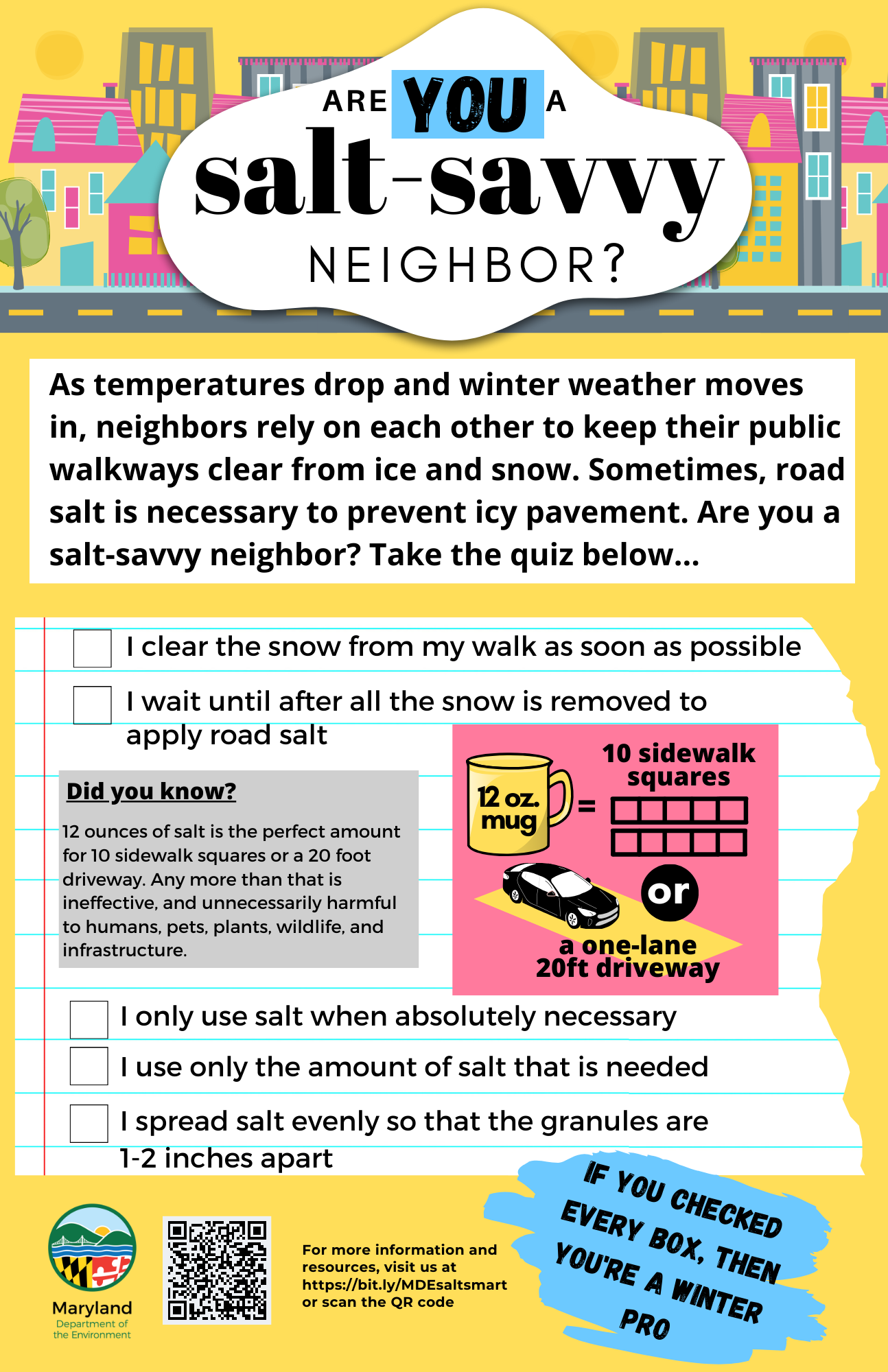
- One 12-ounce coffee mug of deicer can treat 10 sidewalk squares or 20 feet of driveway!
- Sweep up leftover salt after ice melts and reuse it!
- Try pet-safe deicers that are less irritating to paws and less toxic if ingested than traditional rock salt. They may use ingredients like Urea, Magnesium Chloride, or Calcium Magnesium Acetate (CMA), or can be entirely salt/chloride-free.
- Consider using sand, mulch, or non-chemical traction products where possible.
- De-icers and salt are not meant to replace shoveling. They are meant to loosen ice so it can be shoveled away.
- Use solar power! If temperatures are expected to rise, de-icers or salt may not be needed. Clear/shovel away much of the snow and let the sun do the rest.
Did you know?
- When pavement temperatures drop below 15°, salt won't melt ice. So, check the weather forecast before applying!
- Deicers can be reused! If salt granules can still be seen after a storm, sweep them up to use the next time winter weather hits. It'll save you money AND keep salts out of waterways!
Reduce salt and cut costs!
Landscaping and snow removal professionals play a critical role in keeping roads, sidewalks, and parking areas safe during winter weather. How deicing materials are applied can also have a significant impact on local streams, soils, and infrastructure.
A professional advantage. Efficient deicer use can:
Lower your material costs.
Reduce equipment and surface damage.
Protect local waterways and the Chesapeake Bay.
Demonstrate environmental stewardship to clients.
Responsible deicing offers long-term value to the properties you service and shows that your staff are well trained. AND it can save your business money by not wasting materials or labor!
So, what's the problem?
After snow and ice melt, excess deicer is washed into storm drains. Water in these drains does NOT get treated- it flows directly into nearby waterways. Elevated salt levels can:
Harm fish and other aquatic organisms.
Degrade soil quality and damage turf, trees, and landscape plantings.
Contribute to corrosion of concrete, metal, and vehicles.
Increase long-term maintenance and infrastructure costs for buildings, roadways, and landscaped areas.
More salt does not mean better performance.
Over-application of deicer can actually reduce traction and effectiveness, especially at very low temperatures. Applying only the amount of salt needed—based on pavement temperature and site conditions—improves safety outcomes while reducing waste and environmental impacts.
Access free training!
The Maryland Department of the Environment offers info and resources for professional salt applicators: https://mde.maryland.gov/programs/water/319NonPointSource/Pages/saltapplicators.aspx
Top tips for winter weather professionals
Property managers, landscapers and snow crews can be Salt Smart by:
Always storing salts in a covered structure to prevent it from blowing away, getting wet, or washing into storm drains.
Shoveling or plowing first to limit the amount of deicer needed.
Calibrating spreaders regularly to avoid over-application.
Determining how much salt is actually needed for the surface type, square footage, and weather. Here's an example of a calculator tool: https://www.uvm.edu/seagrant/deicing-product-application-rate-calculator
Applying deicer only to high-risk or required areas, such as entrances, slopes, stairs, and crosswalks.
Avoiding application before rain, which can wash materials directly into storm drains.
Training staff on proper application rates and environmental impacts.
Using "green" alternatives when possible, such as non-chloride, pet-safe salts, or chemical-free products to increase traction, like sand or mulch.
Always clean up any spilled or excess salt- you can reuse it!
- Citizen science helps monitor salt in the watershed: https://iwla.org/salt-watch/
- "Salt Story Map" by the Maryland Department of the Environment (MDE) https://maryland.maps.arcgis.com/apps/Cascade/index.html?appid=b3c8425c387348659273eb889b007edb
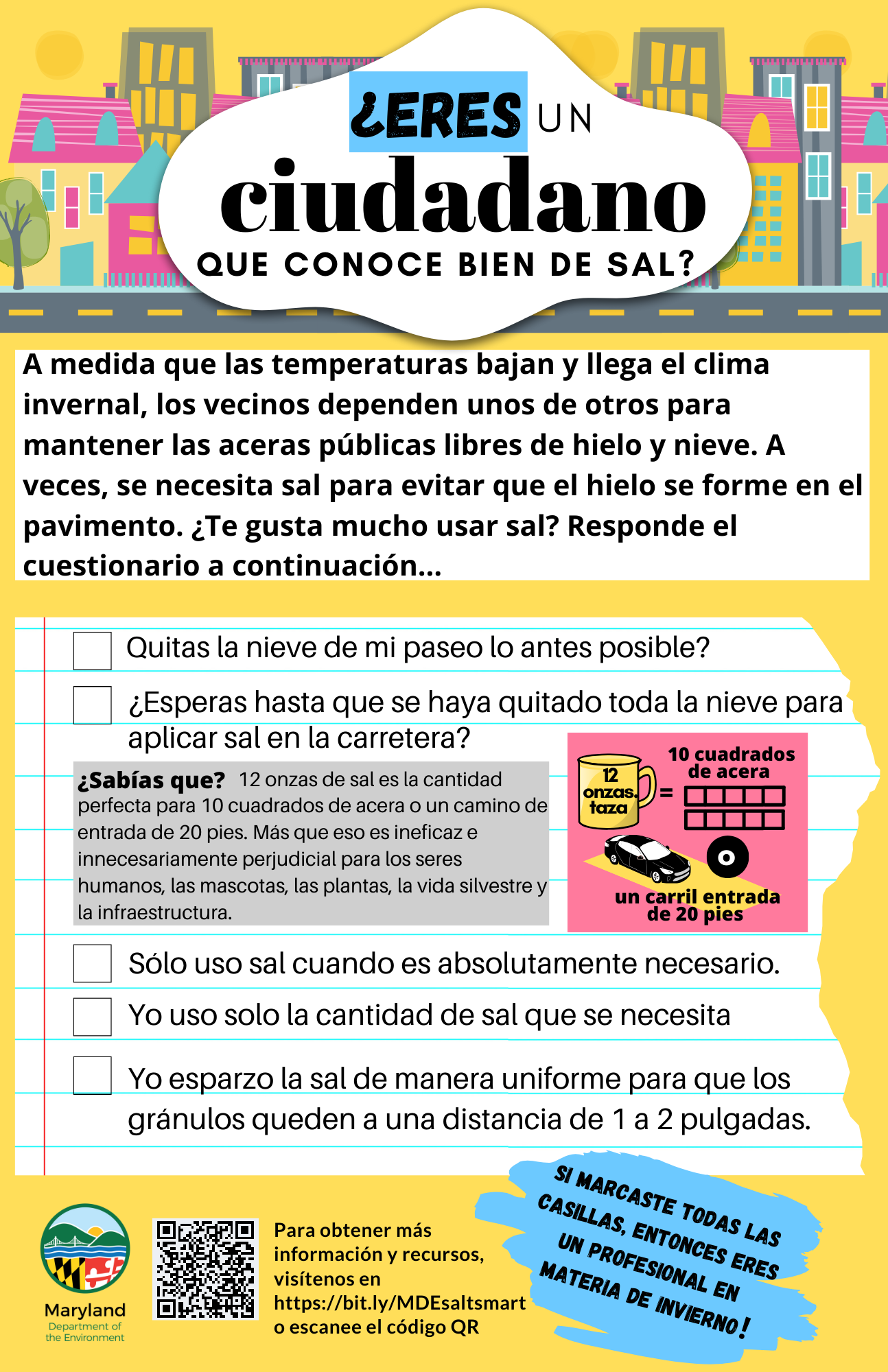
- MDE's "Smart Savvy Neighbor" checklist: https://mde.maryland.gov/programs/water/319NonPointSource/Documents/Salt_Files/SaltSavvyNeighbor_eng.png
- University of Maryland's free Winter Maintenance Training series for landscapers, property managers, salt applicators, etc. Offers CEU credit: https://lp.constantcontactpages.com/cu/UtRAwXJ/SmartSalting
You can help monitor salts in the environment!
The environmentally-focused nonprofit Izaak Walton League of America has been running a citizen science program since 2018 called "Salt Watch." The goals of Salt Watch are to raise awareness in the general public about the connection between road salt and public health, to identify waterways with high levels of road salt pollution, and to advocate for smarter salting practices by sharing Salt Watch results.
You can request a free water sampling kit to help monitor a local stream! Visit https://iwla.org/salt-watch/ to participate.